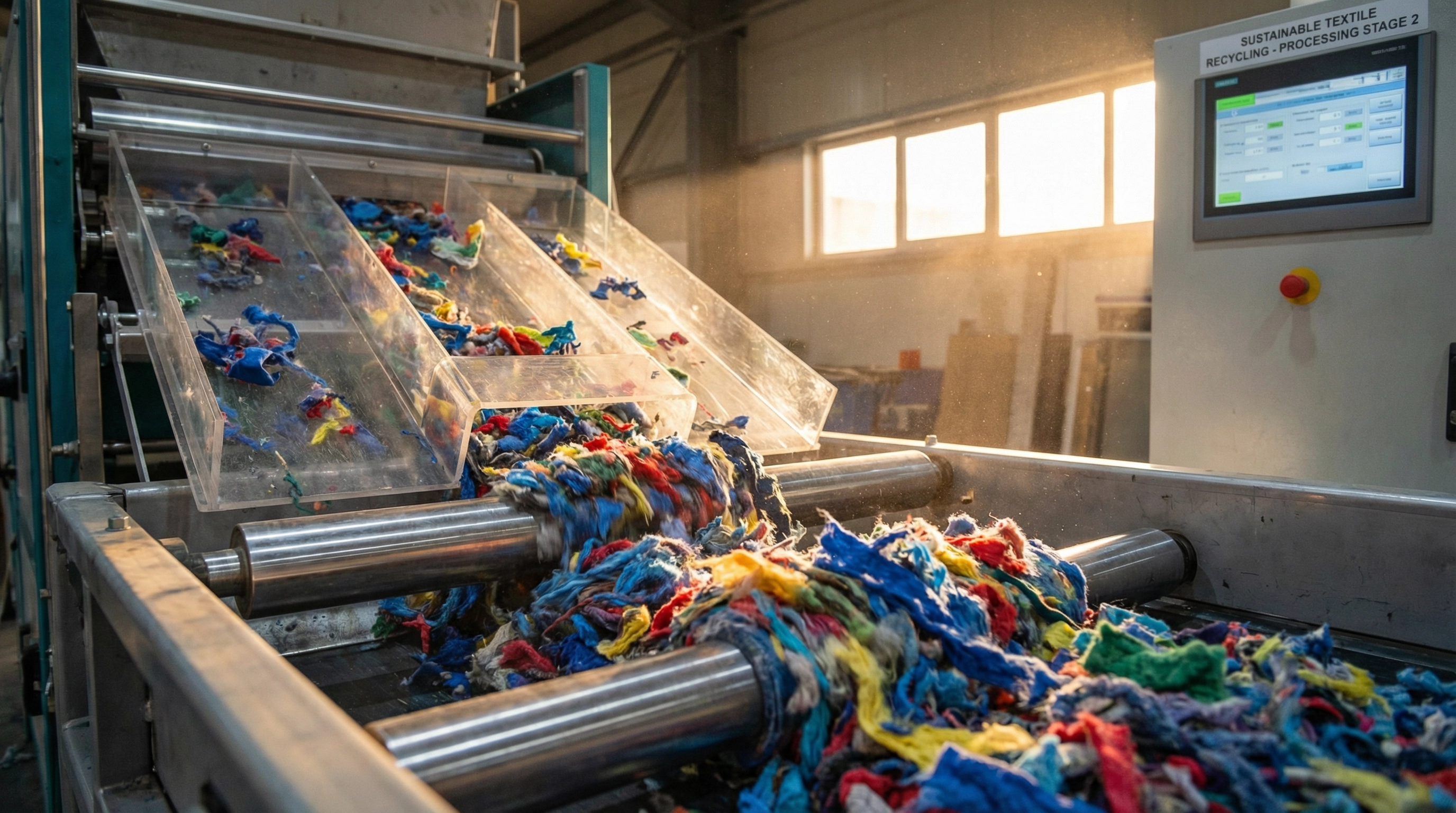

Introduction: Challenging the Textile Waste Paradigm
Textile recycling presents itself as the most viable and scalable solution to the fashion industry's waste crisis. However, its potential is often obscured by a series of myths and misconceptions that hinder the investment and innovation necessary for sector transformation.
This article dismantles the five most persistent myths about textile recycling, demonstrating that current technology has overcome the limitations of the past.
Historical Context and the Need for Innovation
Textile recycling is not a new concept. Since the Middle Ages, the practice of reusing fibers has been a constant. Today, less than 1% of material used to produce clothing is recycled into new clothing, representing a value loss of over $100 billion annually.
Myth 1: "Only Pure Cotton Can Be Recycled, Blends Are Impossible"
Technological Reality
Chemical recycling technology has made fiber blends, especially polyester/cotton (60% of textiles), not only recyclable but separable into their original components with near-virgin purity.
Pioneering companies are achieving recovery rates of up to 98% of polyester from cotton/polyester blends.
Myth 2: "Textile Recycling Is Too Expensive"
Technological Reality
Intelligent automation and process optimization are dramatically reducing operating costs. AI-based sorting systems can process up to 4 tons per hour.
| Technology | Function | Benefit |
|---|---|---|
| NIR Spectroscopy | Composition identification | Millisecond classification |
| AI Vision | Color and type analysis | Millimeter precision |
| Pneumatic Systems | Automatic separation | Industrial speed |
Myth 3: "Recycled Textiles Are Always Lower Quality"
Technological Reality
Chemical recycling enables upcycling or, at minimum, maintaining original quality. The concept of downcycling applies primarily to obsolete mechanical methods.
Myth 4: "Textile Recycling Has No Significant Environmental Impact"
Technological Reality
Substituting virgin fibers with recycled fibers offers quantifiable and massive environmental benefits:
| Metric | Virgin Polyester | Recycled Polyester | Savings |
|---|---|---|---|
| CO2 Emissions (kg/kg) | 5.5 | 1.5 - 2.0 | 60-70% |
| Water Consumption (L) | 10 | 0 - 5 | 50-100% |
| Energy Use (MJ) | 125 | 40 - 60 | 50-70% |
Myth 5: "Processing Infrastructure Is Too Immature"
Technological Reality
Smart logistics systems and modular processing centers are being rapidly implemented:
- Collection Digitization: AI applications and platforms optimize routes.
- Blockchain Traceability: Instant identification of composition.
- Modular Plants: Decentralized centers near consumption hubs.
Conclusion: The Future Is Circular and Technological
The five common myths about textile recycling have been debunked by technological innovation. From chemical depolymerization to AI-based sorting systems, textile technology has transformed recycling from a low-value process to a high-tech, high-performance solution.